Saturday, 29 October 2011

Bits and Pieces [7]

--------------------------------------------------------------------
fbb has had heavy Church commitments for a week
so whilst he was busy with
Hermeneutics, Hospitality and Horganisation
 a series of mini-blogs has been published, entitled
       "BITS AND PIECES"     
Today is the last of these busy days. Phew!
-------------------------------------------------------------------
Exciting Exclusive Experimentation 

It was in 1973 that the Passenger Transport Executives were formed. They took over all municipal bus operations in the area and had a remit to work with company operators and the railways to co-ordinate and improve services for the public.

In South Yorkshire, there were experiments in logo ...
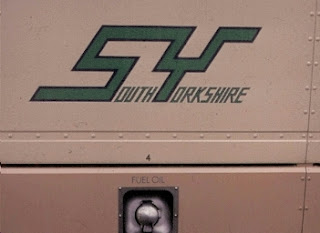
... seen here with the insipid "pale coffee" colour first used to offset the cream. There were experiments in livery layout ...
... and a much darker colour. A mid-brown coffee was eventually adopted.
Like coffee itself, not always to everyone's taste.

fbb has, in the past, referred to experiments with articulated buses. In July 1976 SYPTE ran a left hand drive vehicle on free trips for Joe public and later became a pioneer of the iconic bendybus; subsequently despised by Boris-the-Blue.
What is less well documented, however, is the PTEs experiment with "modern" trolleybus operation in 1984. A standard PTE double deck vehicle was fitted with trolley poles and an electric drive train and operated under a short length of overhead wiring near the Ascot Drive, Doncaster, depot. From time to time "rides" were offered to the public.
The trolleybus idea was not pursued, doubtless killed off by privatisation and deregulation; perhaps sadly, in view of present-day discussions about "greener" travel.
But the vehicle itself is preserved, seen here at the Sandtoft Trollybus Museum. (web site here)

One of the more significant "experiments", however, was to evaluate and commission the "standard" SYPTE double decker. Ironically, this takes us back to 1978 and back to Arbourthorne!

Of this, more tomorrow.

P.S. Have you remembered to put the clocks back tonight?

Or is it forward?

What happens to all-night buses? Do some run twice?

Next blog : due Sunday October 30th
 normal blogging resumes on Monday 

Friday, 28 October 2011

Bits and Pieces [6]

--------------------------------------------------------------------
fbb has heavy Church commitments for a week
so whilst he is busy with
Hermeneutics, Hospitality and Horganisation
 a series of mini-blogs will be published, entitled
       "BITS AND PIECES"     
-------------------------------------------------------------------
more slides with rigor mortis ... 
What's going on?
An empty bus without its driver stopped outside fbb's home at the summit of the steep Crimicar Lane in Sheffield. The photo is simply a reminder of a very spooky evening in the mid 70s. At sunset the temperature had dropped dramatically and the road had frozen over. BLACK ICE!

Over the brow of the hill came a sequence of service 60s, applied their brakes and simply started sliding totally out of control down the hill. At one point there were three buses at various angles totally blocking the road. Their somewhat shaky drivers sitting in fbb's living room drinking hot sweet tea.

Eventually, the gritters arrived and the vehicles regained their grip and returned to depot, shaken but not stirred.
 
Buses on West Bar, Sheffield with a little knot of policemen? Link that to this shot ...
... and wonder what's going on. Special football buses from City to Parkside Road Hillsborough were standard way back in Sheffield Transport days, but provisions for F A Cup semi-finals were a bit special with large numbers of vehicles waiting patiently for the final whistle. Drivers has a pass to watch the match but had to leave before full time to be ready to leave.

And what is happening here?
It was a "ring junction" experiment, staged by the Ministry of Transport, as it was then.

So what was (or is) one of those? Simply explained, a mini-roundabout is established at every entrance to a large and "proper" roundabout. The big roundabout then becomes a two way "ring-shaped" road and drivers can choose which way round the junction they go. fbb ALWAYS went the long way round as a matter of principle.

Trams now trundle across this junction in Sheffield, where Brook Hill and Netherthorpe Road intresect. The shot what taken from the roof of one of the Nertherthorpe tower blocks, fbb having been invited to view from where the men from the Ministry where filming their experiment.

The so-called "Magic Roundabout" in Swindon was similar and more well known ...
... but its road sign explains the principle. The Sheffield experiment was relatively short-lived, the Swindon scheme was eventually superseded and "Ring Junctions" have now joined the illustrious history of unsuccessful road management experiments.

Sliding buses, football specials and ring junctions - all part of the rich tapestry of public transport operation from days gone by.

Happy memories!

Next blog : due Saturday October 29th
  normal blogging resumes on Monday  

Thursday, 27 October 2011

Bits and Pieces [5]

--------------------------------------------------------------------
fbb has heavy Church commitments for a week
so whilst he is busy with
Hermeneutics, Hospitality and Horganisation
 a series of mini-blogs will be published, entitled
       "BITS AND PIECES"     
------------------------------------------------------------------- 
Gold or Gullible at Stoke?
One of the delights of modern bus marketing is the promotion of frequencies on route-branded vehicles. The phrase "up to every 10 minutes" can be somewhat misleading. fbb has been looking more closely at First's "Gold" services in Stoke. On the (very) diagrammatic route map we are offered "Daytime ...
... of the route. So for the 25 we have:-
And for the 26 it shows:-
Simple question : is this true?

Simple answer : absolutely not!

Firstly, the easy one. The 25 runs every 10 minutes Monday to Friday daytimes ONLY. On Saturdays it is every 20 minutes. Evenings and Sundays every 30 minutes. You can see the full timetable here.

The 26 runs for the full length of the route only every 20 minutes Monday to Saturday, with a slight enhancement to every 15 on Monday to Friday peak hours. The basic service 26 timetable can be viewed here. Evenings and Sundays the route runs only every hour.

So, where does the "every 10 minutes" come from? A better map than on the original blog will help:-
26A journeys run from Newcastle via Stoke, Meir and Weston Coyney to Park Hall every hour, (timetable here) and to Coalville twice an hour, (timetable here).

These extra journeys ONLY run Mondays to Fridays, giving the advertised "every 10 minutes" and then only between about 1030 and 1530.

It's not quite what the promotion would suggest.

The moral of this tale? Treat phrases like "up to every 10 minutes" with polite suspicion until you have a full printed timetable in your clammy hands.

Next blog : due Friday October 28th

Wednesday, 26 October 2011

Bits and Pieces [4]

--------------------------------------------------------------------
fbb has heavy Church commitments for a week

so whilst he is busy with
Hermeneutics, Hospitality and Horganisation
 a series of mini-blogs will be published, entitled
       "BITS AND PIECES"     
-------------------------------------------------------------------
Last Bus ... EVER
Recently fbb blogged about villages inundated by the construction of the Ladybower reservoir. See "A Delightful Derbyshire Diversion [3]" (read again). The picture above shows Derwent in 1905, then a happy hamlet, bustling with life despite its remoteness.
 
Tom, keen and respected official of the Sheffield Transport Study Group, kindly sent this image captioned "Last bus from Ashopton". Not wishing to "split hairs", fbb reckons it should be "Last Bus from Derwent" as it is a service 47 and there is no sign (on the full version of the shot) of the construction work on the Ashopton Viaduct . fbb thinks (?) the bus is standing, having reversed, in the little road to the right of the last of the cottages on the left.

Service 44 had been introduced to serve the displaced population now living at Yorkshire Bridge. And in the mid 60s, that's where you might meet this beastie.
Bus No 900 (later 90), a luxury coach with centre entrance, was actually bought to convey the Sheffield City Transport Committee on site visits. When it was not so required, it was available for private hire or, of course, daily service carrying a driver and a conductor to slide the manual centre door. Not suitable for busy routes, it found itself fairly regaularly on the route 44, later 244.

The vehicle was known affectionately as "The Blunderbus".

It was the 44 that was chosen to be the very first post-WW2 one man operated route, starting in July 1967. fbb well remembers rushing our of Birkdale Preparatory School in his lunch break, running along Ashdell Road to its junction with Glossop Road ...
  ... to watch the 44 storm past just after 1230.
This particular "trial run" carried driver and conductor, as it was deemed to be still "experimental", two inspectors, two union representatives and two head office staff. Oh, and two genuine passengers. Having seen this "revolution" in bus operation pass by, fbb ran (really, ran!) back to be in time for his first lesson; "un peu de français, peut-être; avec les jeunes élèves de 3B."

It would not have been acceptable to be late. A dressing down by our beloved dictator headmaster would be the inevitable consequence.

Incidentally, near the end of Ashdell Road was a "gents hair stylists" aka a barber shop. It was here that fbb's golden tresses were ritually shorn every month or so. The barber was also a driving instructor and taught fbb to pass the much less stringent test of the 1960s.

fbb passed first time after only 10 lessons. Big-ed!

Next blog : due Thursday October 27th  

Tuesday, 25 October 2011

Bits and Pieces [3]

--------------------------------------------------------------------
fbb has heavy Church commitments for a week
so whilst he is busy with
Hermeneutics, Hospitality and Horganisation
 a series of mini-blogs will be published, entitled
       "BITS AND PIECES"     
-------------------------------------------------------------------
Unusual Underground
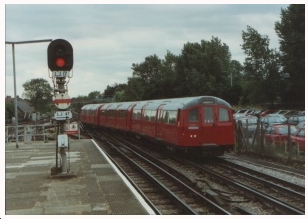
Another long lost and tatty slide from fbb's "collection", date unknown. The train, on the circle line, is approaching Farringdon Station from the north. The road behind the train is Turnmill Street and much has changed since the mid 60s when fbb took to picture.

We now look south, standing on the bridge under which the train is travelling, and ...
... the building with the distinctive archways is far left, a Circle Line train is leaving the station travelling north and the Thameslink tracks with their long platforms are on the right. The ramp to a car park, from where fbb took his snap, is replaced by the office block on the right.

But it was over 45 years ago!

And so was this one, again 60s:-
Nothing special? A Central Line Train on its way to White City. But the little knot of suited gents talking to the driver and an LT official had just had a ride on the shuttle service from Hainault. They were a delegation from Japan. [Bad Granmmar. "It was a delegation from Japan"] 

So what was so special about the Woodford to Hainault shuttle ...
... now replaced by through trains via the "Fairlop Loop"? It was where LT was testing out automatic train operation before it installation on the Victoria Line, which became the first automatic railway in the world.

Please don't tell anyone; but fbb had also had a ride on an automatic shuttle that day, unofficially and in the cab! As the driver (pal of one of fbb's chums) said, "we're getting so many visitors, no one will ever notice!" As a final act of joy and excitement, fbb was allowed to turn the train lights off after leaving Chigwell Hill Tunnel.
He turned them off too early, leaving the rear car in momentary gloom!

And finally this:-
On his recent trip to Watford Herts (read again), fbb was surprised to be overtaken by a "Piccadilly Line" train on the fast Metropolitan lines north of Harrow. It turned out to be a preserved Cravens bodied train used for tours and excursions. The appropriate web site, for further information, can be visited here.

Next blog : due Wednesday October 26th  

Monday, 24 October 2011

Bits and Pieces [2]

--------------------------------------------------------------------
fbb has heavy Church commitments for a week
so whilst he is busy with
Hermeneutics, Hospitality and Horganisation
 a series of mini-blogs will be published, entitled
       "BITS AND PIECES"     
-------------------------------------------------------------------
Catching Tadpoles
Has fbb finally entered his second childhood? There are those who think, as a bus and train enthusiast, he has never left his first!
But this is Southern Vectis bus 519, a Bristol Lodekka with ECW bodywork. It is loading in Ryde bus station and about to set of for the steam railway at Havenstreet.

And this is "Tadpoles", bus 519 no less, in  a very different guise.
The bus was sold to Top Deck Travel in 1978 and used for 20 (yes, twenty) overland "adventure" trips to Nepal. It returned "home" in 1998 and now resides in happy retirement at the Isle of Wight Bus Museum.
But! This September, eleven young people from all over the world quit their jobs and started driving 10,000 miles from London to Sydney in "Tadpoles" in a re-creation of one of the original "Top Deck" trips. Their web site can be viewed here.

And their latest logged location (this blog assembled on Wednesday 19th, so they will have gone further since) is:-

Next blog : due Tuesday October 25th  

Sunday, 23 October 2011

Bits and Pieces [1]

--------------------------------------------------------------------
fbb has heavy Church commitments for a week

so whilst he is busy with
Hermeneutics, Hospitality and Horganisation
 a series of mini-blogs will be published, entitled
       "BITS AND PIECES"     
-------------------------------------------------------------------
The Bus to Billing
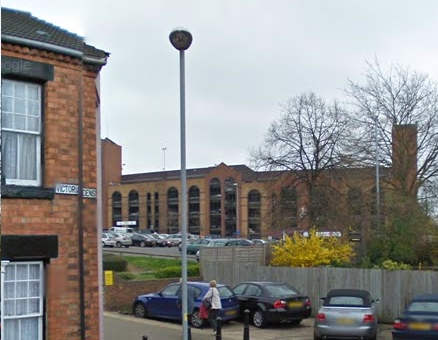
An old decaying color slide reminds fbb of his childhood routine. It was a walk from Northampton town centre, along Derngate and down to Victoria Promenade. That's where Yorks bus departed from and the picture above shows the blue York's bus in the service's declining years being overtaken by a United Counties Lodekka on its way to the former Derngate bus station. To the left was the cattle market, now replaced by a Morrisons store ...
... but the row of bay-windowed houses is still there today. One route to the stop involved walking under a very low and mysterious bridge, the former road being blocked, even 60 years ago, by iron bollards. This had once carried the Midland Railway line between Bedford and Northampton to its terminus at St Johns Street Station; the green line on the map. 
The former station was here ...
... but nothing now remains, even the mystery bridge has gone, BUT the informed observer might just notice an odd mound of earth near Morrisons entrance.
This is the last piece of evidence for the embankment that raised the line to cross Victoria Promenade. The line had opened in 1872 and passenger services were diverted to the less conveniently located Northampton Castle station in 1939.

fbb wonders how many Morrisons shoppers might realise that they drive past a two little bits of transport history; a former and popular village-bus terminus and a piece of railway line and its station closed 72 years ago.

Next blog : due Monday October 24th