Sunday, 11 September 2011

Euston, We have a Problem [5]

Underground Upheaval

This is where it all started. No. 3 son asks, "What's that underground station that isn't an underground station just outside Euston?"

This starts fbb on a quest for the complex history of the terminus of the first railway line to reach London, way back in 1837.
By the date of this 1888 map, the view of Euston's Doric Arch from Euston Square had become blocked by the station hotel. But, effectively, the entrance to the station's appurtenances was on Drummond Street. The 1960's station rebuild brought the main entrance and the subsequent office block and bus station further south to the "Euston" of Euston Square on the above map. The eastern and disconnected bit of Drummond Street was renamed Doric Way.
It was on the corner of Doric Way and Euston Road that the City and South London Railway [C&SLR] built the terminal station for its extended underground line, opening it on 12th May 1907.  The building was designed by Sidney R J Smith; as a cladding to the steel frame, Smith used white and green Doulton's Carrara-ware faience with florid detailing. Lifts descended to the single C&SLR island platform.
 
A subway was opened to the main line terminus on 18th May. 

From 22nd June that year a low level passage and interchage ticket office ...
 
... linked the C&SLR and and the newly opened Charing Cross, Euston and Hampstead Railway platforms. This map shows exactly where the two separate stations were located.
The Hampstead line had its own separate buildings on the west side of the main line station. This is the structure that fbb's No. 3 son spotted, and, indeed recognised as a former Undergound Station. The station was designed in "house style" by Leslie Green.
No 3 son had, correctly, recognised a style similar to may other currently operational stations. Well done, son; we'll make a transport enthusiast of you yet! [son replies, "Not on your nelly, fbb!"]
Leslie Green was responsible for buildings on what became the Northern, Piccadilly and Bakerloo lines which all opened in 1906 and 1907. The pressure of producing designs and supervising the works to so many stations in such a short period of time, placed a strain on Green's health. He was elected a Fellow of the RIBA in 1907, but contracted tuberculosis and died on 31 August 1908 at the age of 33.
Entrances were opened within the main line station and in the 1920s, the City line was extended again to join the Hampstead line at Camden Town. Linking passageways were built at (underground) platform level and a single booking office opened under the main station concourse. And so it has remained, though adaptations and additional access have altered the detailed layout from time to time.
 
A significant development was the arrival of the Victoria Line in 1968. The former island platform on the City line was extended for southbound trains and new tunnels were built for northbound services thus permitting cross platform interchange with the new line. 33 years later, the Northern and the Victoria lines ...
... both have brand new trains; capacity is being increased via new signaling and Underground traffic continues to grow.

The next big change would come with the building of the new "High Speed 2" line northwards from Euston. A  below-ground link has been promised with the Circle Lines at Euston Square.
Such a link would ease the route of passengers interchanging with main line services at Paddington and Liverpool Street as well as giving access to Metropolitan Line destinations. More Undergroud Upheaval but, ultimately, more benefits for its customers.

Despite rebuilding in the 60s and the addition of extra platforms in the early 80s; despite slicker turn-round times with modern "multiple unit" stock; the main line station is now nearing maximum capacity. Euston almost certainly NEEDS High Speed 2.
Finally (and soon) we take a tortuous tour round the bus terminal conveniently located right outside the station building.

Or is it?

Next blog : Monday September 12th  

Saturday, 10 September 2011

Euston, We Have a Problem [4]

Dan and Doric Arch ...
A Tale of Conservation Folk**

Adolf Hitler has a lot to answer for. Perhaps, just perhaps, had WW2 not intervened, a brand new Euston would have been built. Plans were discussed in the mid 30s. Preliminary sketches suggest a design adapted from American practice with a huge station building acting as a gateway to the platforms.
Certainly this would have been a rival for St Pancras and a definite nose thumbing to the rather mundane Kings Cross, both a little further east along the Euston Road.

But it was the 1960s electrification which led to the complete rebuild. Debate was heated over the new station's bland and functional design. But, as opened, the concourse was not cluttered with the now obligatory retail outlets (Do normal people really buy ties and socks at a railway station?).
The clean and then unblemished marble floor, leading to obvious and tidy platform access gateways, was such a breath of fresh air compared with the previous rabbit warren of passageways and  dingy dark corners that one could forgive British Railways for being less than spectacular with the station frontage.

But "The Arch", we were told, had to go. See also Euston, We Have a Problem [3] (read again)
 
Protests were led by that indefatigable enthusiast for all things Victorian, John Betjeman ...
and approaches were even made to the prime minister himself! 
All to no avail. Soon the arch was no more.

The batten for rebuilding the arch was taken up by TV historian, Dan Cruikshank. Two TV programmes were made about the search for the remains of the Doric propylaea (It was never an arch). In the first documentary, a breathless and excited Dan found some bits in a rockery at the house once owned by the demolition contractor.
 
After this first programme was aired, Dan was approached by  Bob Cotton ...    
... who had worked for British Waterways. He had been responsible for buying the rubble and using it to plug a hole in the bed of the Lea Valley Navigation in London. So off goes Dan, a big crane, divers and a TV crew to have a bit of a paddle. 
And, to the thuderous and tear-jerking sounds of dubbed music, there it was. An easily recognisable chunk of one of the distinctive fluted columns. 

It is doubtful whether the original arch could ever be rebuilt, largely because of the cost of recovery and the damage done by the demolition workers. But there is a glint of a possibility. The proposed High Speed 2 line from London to Birmingham and the North is due to terminate at a brand new and much extended Euston.
  
At least one proposal for the rebuild has a reconstructed "Doric Arch" as its centrepiece.
So the vandalism of the 60s might, possibly, bring a grand act of repentance in the "new 20s". That would be, as the youff of today says, "cool"! Meanwhile, have a pint in the station pub and dream ...
**This tag line is an oblique reference to Dan and Doris Archer (pictured here, centre),
 
eponymous partiarch and matriarch of Ambridge in radio's "story of country folk". So we end with the familiar chords of  "Barwick Green", the programme's signature tune; only we don't. "Doing sound" is just too tricky for fbb; so you'll have to hum. "Dum de dum de dum de dum dum de diddly dum dum..." etc.
 
So, at the moment it's Doric Arch R.I.P. in a watery grave. Will it ever be "long live the Doric Arch"?

More information here.

Next blog : Sunday September 11th
  "Underground Upheaval" at Euston   

Friday, 9 September 2011

Web Sites, Used or Confused? [4]

------------------------------------------------------------------ 
Are They Having a Laugh, STILL?
Readers will recall the blog on utterly ludicrous bus stop
publicity (read here) and Travel South Yorkshire's almost as 
ludicrous attempt at a correction (read here).
A chum emailed yesterday (Thursday) to report that TSY
have just replaced the corrected information once again ...
... with the original utterly ludicrous version.
 
This man, David Brown, the Director General, is
ultimately responsible. They sack failed football managers!
You couldn't make it up.
------------------------------------------------------------------  
It makes the Isle of Wight look reasonable : nevertheless ...

Gatcombegate, The Final Word
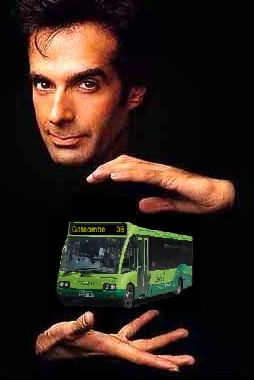
With rumours flying around the ether about buses to Gatcombe, near Newport, Isle of Wight; a possible vanishing act by David Copperfield, grand illusionist, and some shirty comments by "anonymous" appended to fbb's previous blog (read again), more research was obviously needed. Most of fbb's previous conclusions were based entirely on publicity currently available, on-line and in print; so anonymous' somewhat pained reaction might suggest that he (or she?) had the benefit of insider dealings.

Fact 1  : until Friday 2nd September, Gatcombe Church was served by route 36 operated by Wightbus.
Fact 2 : from Monday 5th September, route 36 was replaced by the very similar (almost identical?) but curiously renumbered route 35, operated by Southern Vectis.

Fact 3 : route 35 lies hidden in Traveline's list of timetables ...
with no mention of the journeys via Chillerton and Brighstone in the index, so tricky to find the information, eh?

Fact 4 : According to Southern Vectis' new timetable from 5th September, route 35 no longer serves Gatcombe Church.
Fact 5 : Despite this omission, it appears that route 35 does serve Gatcombe Church, at least according to Traveline's map.
 
fbb, foolishly had not spotted this. Additionally his usually reliable source was adamant that the 35 did NOT run via Gatcombe Church now that the NEW 36 was operating.
 
Indeed an "informed source" from the Isle of Wight Council, when pressed,  seemed unsure which way the 35 would actually run. BUT .... fanfare of trumpets ... sound of fbb tucking into humble pie ... chortles from anonymous as he shouts "told you so" ... an even more reliable source from Southern Vectis confirms that both the 35 and the new 36 serve Gatcombe Church, giving that pretty ecclesiastical edifice (there's not much else) three trips to Newport on Mondays, Wednesday and Fridays at ...

0918, 1050 and 1118

... and three journeys back home at ...

1110, 1250 and 1410

A fantastic service giving the particular privileged passenger a huge choice, better than ever before.  An fbb map explains all ...
... or does it? The official registration for the 35 is shown in green. It implies that the 35 bus does a "double run" from the main road, turning at the Church (which is here, in the trees on the right on a dangerous bend with poor visibility).
As fbb's alter ego, Victor Meldrew, might have said ...
"I don't belieeeve it!" 

And the question which, in a way, started all this, still remains. Why run the 36 AND the 35 for minimalist passenger numbers at one solitary stop, roughly a quarter of a mile from the hourly service 6 on the main road and not particularly near the main settlements in Gatcombe? There is certainly a faint odour of ratus ratus in the Island air.

Gatcombegate, the Final Word - OR IS IT?   

Not quite, there's another question. Why is the 36 still a secret in all printed and SV on-line publicity? Perhaps illusionist Copperfield may yet be preparing one of his celebrated vanishing acts?

And another question. How is Joe Public ever going to work this lot out

And, by the way, another of fbb's chums reports that, so far (on Thursday, the fourth day of the scheme), he has seen NO "community partnership" drivers on any service 6 journeys, they have all been dressed in smart Southern Vectis uniforms. The "partnership" was, if you remember, for half the 10 trips a day to be run by the community. News is also breaking that the Unions are expressing deep concern about the use of "volunteer" drivers, so possible "trouble at 't mill" may be looming in the not too distant horizon?

Who said something about "Tears before Bedtime"?

Stop Press In order to sort out what is clearly a mess, fbb went back to the public domain information, namely the service registrations deposited with the Traffic Commissioners. This reveals that the 36, part of the 6 documentation, was registered on 21st July whilst the 35 is dated 9th August.

So?

Either a change of heart at the last minute ...
 
... by the ever efficient Isle of Wight Council (pause for hysterical laughter) which foots the bill, OR, an act of mis-management (there are cruder phrases available) by the bus company. "Sorry, guv, we forgot!" But NONE of this is any excuse for the outrageous omnibological obfuscation on-line, and in print, all totally disgraceful. (see comments on the previous blog)

Readers may draw whatever conclusion they wish from:-

Fact 6 : The NEW service 36 is to be withdrawn after service on Friday 21st October, just 7 weeks after its secretive un-launch.

Next blog : Saturday September 10th

Thursday, 8 September 2011

Web Sites, Used or Confused? [3]

Carefully Considering Corby - Today.
Modern technology ought to make things simple, so a click on "Corby" on www.stagecoachbus.com ought to deliver a list of Stagecoach buses running in Corby, in particular the CorbyStar network.

Sadly, the Corby Star brand is not mentioned and the page is cluttered with buses for Kettering, Wellingborough and Northampton. Why?

The site lists "Corby" services as 

1, 2 (two versions), 2A, 3, 3B & 3C, 4, 5, 6 & 6A, 7 and 10

Clicking on some of these actually produces timetable pages but the 2A, 3B & 3C, 6 & 6A and 7 produce an answer similar to this:-
The web site has a route map ...
... showing ALL the above except the 2A, 3B and 3C which might be works services. There is a general note about (unnumbered) works journeys beside "Earlstrees Industry", just off the map extract above. In additional to the "unclickable" 6, 6A and 7 we also have service 5A, not listed on-line.  

What is also not on the map is both versions of service 2!

How about trying the Northamptonshire County Council [NCC] web site? There are many timetable changes from 4th September throughout the county, so sorting out what runs and what doesn't is a little tricky, but in Corby we appear to be offered:-

1, 2, 2B, 3, 3C, 4 & 4A, 5, and 10

Maybe we can find out what happened to 6 and 7 by looking at NCCs map?
    click on the map to see a larger version   

No we can't because that still shows the 6, 6A and 7 and adds back the 5A. Once again important changes do not make it onto maps, doubtless produced expensively under contract by a specialist company. A simple vector graphics (? ask any 7 year old, they will explain it) program costs about £60 and takes very little skill to use. It's what elderly fbb uses, so it had to be very simple indeed.

Still not a graphical word about the enigmatic but excluded service 2! 

Back to the Stagecoach site,then: one of the two service 2s is shown as running to Exeter Estate ...
 
... which appears on both maps with route 4 and 6 beside the roads.
This is getting very confusing indeed!

fbb will explain all - well perhaps not all, but a bit ...

From 4th / 5th September:- 
Corby service 1 is diverted to replace 
         part of service 7 which is withdrawn.
Corby service 2 is revised to run "cross-town" to Exeter Estate
         replacing service 6 which is withdrawn.
Inter-urban service X4 is diverted to replace a bit more
         of service 7
Inter-urban service X1 is diverted to replace a bit more
         of service 6

None of his appears on either map and is only explained on the NCC site in a huge and well-nigh incomprehensible list of changes for 4th September. It lists the changes route by route with no cross-referencing, so you have to guess. The Stagecoach site tells you NOTHING!

Which leaves us with the original and un-extended service 2 to the map-less Priors Hall. That's easy-peasy, patient reader, and only requires an inquisitive mind, the detection skills of Jane Marple and an afternoon on-line.
Priors Hall is indeed north of Weldon, but, far from being a blank on the map, is (according it its publicists) :-
Doesn't that make you fell good inside? No, it makes you rush to the sick bucket! But this "community, but not isolated" does have a Corby Star service 2 every half an hour.
Of course that's Monday to Saturday daytime only; evenings and Sundays, tough luck, you will be very isolated without your own wheels; it's a long way to walk to anywhere!
So, after much tedious and tiring technological trawling, fbb has just about "cracked it". But the key question remains. Do these people (Northamptonshire? Stagecoach?) actually use their web sites? Do they check on customer reaction? Or is is simply a case of "It's all on-line, that'll do".

Web Sites, Used or Confused? "Confused" in shed loads!

Next blog : Friday September 9th  

P.S. Since this blog was written (on Monday 5th) an up-to-date map of the Stagecoach network has appeared on-line. Everything comes to he who waits - eventually!

Nevertheless, bus services have to be registered with the Traffic commissioners eight weeks before they start; presumably new  networks and major changes are planned well before that. Surely there is no excuse for late updating of on-line information?

--------------------------------------------------------------------
Snippet from the Isle of Wight
A new branded route, service 600,
operated by Veolia?
 
every 30 minutes to Pontypridd and Aberdare?
Actually service 9 from Ryde to Newport
 
Being operated illegally by Southern Vectis!
--------------------------------------------------------------------  

Wednesday, 7 September 2011

Web Sites, Used or Confused? [2]

------------------------------------------------------------------------
Intermission!
FirstBus have taken over operation of FreeBee** in Sheffield.
It is numbered 3B. (3B, Free B : gettit?)
This is First's published on-line timetable (Monday to Friday)

Yes, that's all of it! Until  when? Dunno
Saturday times? Dunno 
------------------------------------------------------------------------  

back to today's blog ...

Carefully Considering Corby - the background.

Until 1933 (ish) Corby was a small, insignificant (sorry, fbb doesn't mean to be unkind, Corburians), village in North Northamptonshire. There are still a few bits of the "old" settlement left in "Corby Village".
Expansion came with the development of the huge Stewarts and Lloyds steelworks in 1934. This created what was known at one time as "the largest village" in Britain, later designated an Urban District and known universally as Corby New Town.
Corby Works was a major employer in the area ...
... more accurately, THE major employer in the area. Local and interurban buses were provided by United Counties, this being a service 256 bus that had begun its journey in Northampton.
The new town boasted a centrally sited traditional market place and a simple but unattractive 60s-style concrete bus station.
The end of Stewarts & Lloyds ownership of the works came in 1967 when the steel industry was nationalised for the second time, and they became part of the British Steel Corporation. Due to the high cost and low quality of local iron ore, steel production at Corby ended on 21 May 1980, when the last coil came off the mill. In nearly 40 years of production they had produced almost 2.5 million tons of steel.

But the heart had been ripped out of the Corby community and it is a credit to local politicians and visionary businessmen that the town has survived and is thriving once again. Even in 1978, before "the works" closed, services were hardly attractive (sorry about poor quality, it's an old leaflet) ...
... with a mutiplicity of service numbers (here 275, 276, 279) and potentially confusing notes. The daytime frequency was only every 30 minutes each "way round" on what was the main "Western Circular" town service.

Then, the end of steel production meant a further contraction for local bus services to the point at which they were all becoming unviable commercially. In comes Stagecoach, successor to United Counties, and, in partnership with the local authorities creates a new network ...
 
... "Corby Star", with simple routes and one flat fare, launched in the early 2000s.
The by-now-tatty bus station was demolished and services now all meet in George Street.
Rail services to Corby were first withdrawn in 1966 and then again after an "experimental" shuttle service to Ketttering which ran from 1978 to 1990. A shuttle bus was a less than satisfactory replacement ...
... until a new hourly through service to London from a brand new station finally materialised in April 2009.
So far, so good. Episode 2 looks more closely at what is available today. As might be expected from an fbb blog, things are not as straightforward as they ought to be.

Now there's a surprise. 
-------------------------------------------------------
** FreeBee (or 3B) is a free shoppers bus linking the various bits of Sheffield City Centre. It used to run (as operated by T M Travel) every 7 minutes. First have "won" the recent retendering excercise.
Travel South Yorkshire seems ignorant of the "punny" route number.

Next blog : Thursday September 8th