

Bus Bail Out
Announced at 0001 today:-

The package, agreed jointly with the bus industry, will keep key routes running to provide a lifeline for those who cannot work from home, including those travelling to jobs on the frontline of the UK’s fight against COVID-19, such as NHS staff.
New funding of up to £167 million will be paid over 12 weeks under the new COVID-19 Bus Services Support Grant. As a condition of the funding, bus operators will be required to maintain necessary services at a level which is sufficient to meet much reduced demand, but also to allow adequate space between passengers on board. This is expected to be up to 50% of normal service levels.
The government has also promised that £200 million of existing funding under the Bus Services Operators Grant will continue to be paid as normal even though not all services may run during this time. This funding is usually paid according to fuel consumption, and so the government’s commitment to pay this on pre-COVID-19 levels will help ensure that bus companies are able to benefit despite fewer fare-paying passengers travelling.
This is in addition to up to £30 million of extra government bus funding, originally earmarked for starting new services, which will instead be paid to local authorities to maintain existing services.
That is £167 million of NEW money; £200 million BSOG (used to be Fuel Duty Rebate) exisitng money to be paid despite reduction in services and £30 million re-allocated from new route start-up grant to preserving existing services.
More on the practical implications of this much needed boost to servoces and finances in due course.

Big organisations, like the PTEs, pride themselves on their high-tech solutions to providing public transport information. Small companies may use a sheet of paper and a felt tip pen! Sadly, computers are really, really stupid with a core technology that can do little more than add 1 to 0.
Of course it can do that very very quickly and hardware designers and software developers can use all those 1s and 0s to make exciting things happen. So, you can import a timetable from a bus company electronic registration document, say an electronic "Sim-Salabim" and out pops an on-screen timetable which can be printed (on paper - very passé but quite useful).
Here is a txt from a correspondent concerning "Virus" information from West Yorkshire PTE (aka "Metro").

The 503 is one of the main routes between 'Alifax and 'Uddersfield ...

... branded "Zest" by First Bus. And here is the route description from the PTE's standard leaflet design. The PTE has no truck with branding. "Ay lad, if tha' wants a bus, tha' wants a bus wi' a wheel at each corner. Tha' don't want owt o' that southern poncy Zest mulluck!"

The 501 (which you might think would be the "lead" service) is an evening variation as shown on the timetable below.

So far so good, but if we look at the Saturday timetable ...

... or the Monday to Friday schedule ...

... there is no Zest, all buses have gone for a rest!
This may come as a surprise to First.

There are two possibilities. Either the technology failed to understand that the Sunday service would be running seven days a week and nobody sought to disillusion Deep Throat of its failure to grasp the situation; OR, the person who prodded the computer keys did not really understand what it all meant.

Hay, ho. Power up the Gestetner!
GoTimetable Heathrow - Staggering On.
fbb wants to create a better network map than Transport for London's "Spider" maps, and intends to provide a route diagram to go with each service. There are a goodly number of utilities on-line that can help, but mostly they will plot motoring routes or walking routes.
For the purpose of this demonstration project, fbb will start with the somewhat "basic" TfL route map, in this case for route 222 that runs from Uxbridge to Hounslow via the Bath Road and does not actually make it to any of the Heathrow terminals.
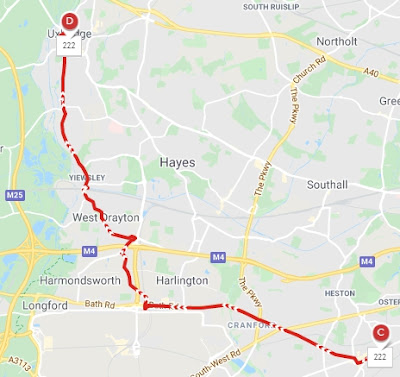 Ordnance Survey now has "open source" maps in the public domain (i.e. for FREE use) and users may well want to investigate them rather than arousing the wrath of the copyright bullies at Transport for London - but, pro tem, this is a demo of principles.
The finished diagram will be limited to 90 and 45 degree joins, so the next input is the fbb version of a set square - and it is square.
 Using this as a guide, he draws straight lines to follow, roughly, the route of the map.
 Sometimes these are less than ideal, especially if the real road is has a lengthy run at less (or more) that 45 degrees as here with Bath Road.
 But remember; the aim is to offer comfort to "foreigners", namely those for whom Sipson and Yiewsley are as remote from their experience as darkest Africa.
Next fbb adds in the corners.
 These are ¼ and ⅛ chunks chopped out of a genuinely round circle. All the joins on the 222 diagram are at 135 degrees, to the smaller of the two curly bits will do.
 Re-orientate the segment ...
 ... place it over the gap and glue the three bits together.
 For cartographic stuff, fbb would normally use Artworks, designed for the successors to the BBC computer range and oh so delightfully simple to use.
Very few users, other than wise but dedicated enthusiasts, still have access to this RiscOS technology. So fbb is currently playing with Xara, once Corel Xara but now independently "owned" - which was actually derived from Artworks.
But it ain't anywhere near as good.
In order to offer compatibility with modern systems, the old man is attempting to learn Xara or, at least, enough of Xara to "get by". AND IT HURTS.
Instead of just joining lines in Artworks (the ends simply attach) you have to select both sections (using the SHIFT key ...
 ... and the select button on the screen).
 Then having selected, you return to the line drawing button ...
 ... and click that. Only now can you join the ends. A right palaver.
But, after ripping out his rapidly thinning hair, fbb has got a line with curved corners from Uxbridge to Hounslow.
But it needs some place names.
For the purpose of this demonstration project, fbb will start with the somewhat "basic" TfL route map, in this case for route 222 that runs from Uxbridge to Hounslow via the Bath Road and does not actually make it to any of the Heathrow terminals.

The finished diagram will be limited to 90 and 45 degree joins, so the next input is the fbb version of a set square - and it is square.


Next fbb adds in the corners.

Very few users, other than wise but dedicated enthusiasts, still have access to this RiscOS technology. So fbb is currently playing with Xara, once Corel Xara but now independently "owned" - which was actually derived from Artworks.
But it ain't anywhere near as good.
In order to offer compatibility with modern systems, the old man is attempting to learn Xara or, at least, enough of Xara to "get by". AND IT HURTS.
Instead of just joining lines in Artworks (the ends simply attach) you have to select both sections (using the SHIFT key ...
But, after ripping out his rapidly thinning hair, fbb has got a line with curved corners from Uxbridge to Hounslow.
But it needs some place names.
Next Heathrow blog : Saturday 4th March
------------------------------------------------------------
Short Thought
The Bible book of Deuteronomy contain quite a bit about the consequences of adhering to the Covenant; but even more about the consequences of rejecting the God deal that is, palpably, a good deal.
The summary is a bit stark.
But if you disobey and refuse to listen, and are led away to worship other gods, you will be destroyed - I warn you here and now. You will not live long in that land across the Jordan that you are about to occupy.
This message is, of course, specific to the Exodus. The Israelites had escaped fro Egypt miraculously and would need to develop from a ragged collection of tribes into the viable nation once they arrived in the Promised Land.
Keeping to the Covenant would be absolutely vital. There would, initially, be no "government", no "society", no human led "security" and a heap big opportunity for messing things up.
But, as is so often in Biblical writing, the specific expands to become general.
The choice WAS stark but it was also very real. Some would suggest that it still is.
------------------------------------------------------------


