Friday, 10 May 2013

Bordon on the Border [4]

-------------------------------------------
Thanks to the Plymothian Transit blog for drawing our attention to a trip which would combine two of the chubby one's interests.
On Wednesday last, were you in the Plymouth area, you could enjoy a tour of Plymouth's post-war churches whilst travelling on a vintage, yellow, left hand drive bus. The destination display does look like the old Plymouth Corporation style. fbb wonders why Plymothian Transit has never revealed details of this fascinating vehicle before.
-------------------------------------------
Go, Go, Eco-town!
At Bordon Camp crossroads, where the A325 intersects with the B3002, is the Fire Station.
It was always part of the military establishment but as a result of cut-backs and re-organisation had been closed for some time. Now this intriguing building rises, phoenix-like, from its impotant past as ...
Bordon Eco-station. You can tell it's "eco" as the doors are now painted green instead of red!

So what exactly is an eco-station? Does it generate "green power"? Will it be the site of the terminus of the rebuilt Bordon railway branch? See "Bordon on the Border [2]" (read again). Will it be the home to strange hippy people making gritty pots and eating sumptuous (?) vegetable stew?

The disused Ministry of Defence Fire Station is being transformed into an Eco-station which will provide community and training facilities. It will also serve as an exhibition centre for the latest eco technology and there will be a dedicated area for the local natural history society.

So it's a "green" community centre!

But that's not all. Because in the grounds of the Old Fire Eco Station is a greenhouse; sorry a "green" house.

This has been built in the grounds of the Fire Station and will demonstrate how low-carbon living can work. The house will showcase a range of building techniques and technologies. The garden will be landscaped using native species and will include a place for growing food.The two/three bedroom home will be open to the public until after the exhibition phase when it will be occupied.
Enjoy 5 minutes of unparalleled excitement as actor Hugh Bonneville (Downton Abbey's Lord Gantham) performs the opening ceremony:-
All very impressive and spiffing, but what about public transport? Those who objected (and continue to object) to the Eco-town scheme have pointed out that public transport is wholly inadequate. 
The appropriate pages on the "Eco" web site offer only the services as outlined in yesterday's blog (read again). Certainly, if the town is to become "green" and rely less on the decidedly "mud-brown" motor car, something better is needed. And there has been a cunning plan ...

... with much "consultation".

Well, perhaps the green shoots of "green" may be appearing, because a band new bus service is starting on Monday 15th May. And fbb will be there! Well, actually, he won't in person, just "virtually"; but a blog or two reviewing the new routes will be a poor second best.

Saturday and Sunday will offer a brief railway/tramway interlude; so blog readers must try hard to contain their Bordon-inspired excitement until Monday!

 Next Bus Tram Blog : Saturday 11th May 

Thursday, 9 May 2013

Bordon on the Border [3]

----------------------------------------------------
fbb came across this little snippet (on the second reading!) in the current issue of Rail magazine.
If they are snipping 100 metres off each platform, how big must they have been before! And the CAF trams must be really hu-u-u-uge!!
 ----------------------------------------------------
So what is an Eco-town?
Eco-towns are a government-sponsored programme of new towns to be built in England, which are intended to achieve exemplary standards of sustainability.In 2007, the Department for Communities and Local Government (CLG) announced a competition to build up to 10 eco-towns. The proposals received support from organisations such as the Town and Country Planning Association but have also attracted controversy and scepticism.
We are local people who think the Government is wrong to want an eco-town here, and the Council is wrong with their plan to double the population of our town. While they make promises they can’t deliver, they do everything possible to conceal the real impact of their plan- a lot more houses, a lot more traffic, a lot of damage to the natural environment and surrounding settlements, and a few more shops and “facilities.” We think the price of these facilites is far too high,

 Once of the concerns is the poor quality of public transport; hence the possible fanciful scheme for the rail link to Bentley as revealed in yesterday's blog (read again).

As eventual successors to Aldershot and District, Stagecoach have been operating two main routes through the town, each every hour.

The 13 runs from Liphook (Mondays to Fridays only) the via Whitehill and Bordon continuing to Basingstoke.
The extension to Liphook is a rather half-hearted replacement for ...
... the ultimately unsuccessful Rail Link bus, also a Stagecoach initiative.
It was withdrawn in 2009 amidst vociferous local protest.

We the undersigned petition South West Trains to save the Bordon to Liphook Rail Link Bus. We condemn totally SW Trains appalling decision to unilaterally withdraw the service on May 17th. This is being done without any public consultation. It will affect Whitehill-Bordon, Liphook and villages in between. Whitehill-Bordon has the worst Accessibility in the whole of Hampshire. We have had wave upon wave of bus cuts from Hampshire County Council and now this. The axing of this link will result in more more traffic, carbon emissions and parking congestion at Liphook station.

A replacement peak hour shuttle, numbered 12, was run for a short time by AMK Travel.

East Hampshire District Council, which has been subsidising the bus since last summer, confirmed that the number 12 will be withdrawn from service on Saturday, June 5 2010.

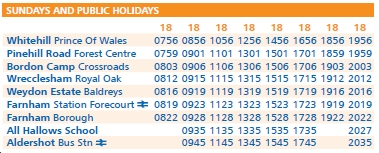
The only other "proper" route via Bordon is the 18 ...

... which does a loop via Bordon centre en route from Aldershot to Haslemere. The only Sunday bus to the Eco-town  is a two hourly "short working" of the 18.
For the record, service 73 on the map above is a selection of shoppers oddments to Petersfield whilst the 737 is used for a very few Alton College trips.

Those who are opposed to the concept of the Eco-town are right to be suspicious; without improved public transport the idea of reducing car use, cutting nasty emissions and being a greener Eco-environment is, simply, a non starter.

But Eco-greenish things are beginning to happen, as we shall see tomorrow.

 Next Bus Blog : Friday 10th May 

Wednesday, 8 May 2013

Bordon on the Border [2]

----------------------------------------------------------
A bank holiday diversion ...
... was a trip to Ventnor with No 1 son and family. One change not previously spotted in the town was yet another example of the Isle of Wight Council's policy of making life inconvenient for visitors. The very useful toilets ...
... ideally located near the beach and the main sea front car park, have been rebuilt ...
... as a holiday cottage.

The nearest alternative source of relief is right at the other end of the Esplanade, maybe half a mile away and beyond the "rotunda" building seen in the distance on fbb's sun-drenched holiday snap above.

Very inconvenient indeed!
----------------------------------------------------------
Back to Bordon.
A curving line of trees marks the route of the railway track from Bentley (on the present SouthWest Trains line to Alton) to Bordon that opened in 1905. There was one intermediate station named Kingsley Halt ...
... hardly a lavish facility.

These platforms formed the terminus at Bordon ...
... and to the right of the LSWR line, the Longmoor Military Railway had its separate but adjacent facilities.
Authorised for construction from 1902, activities date from 1903 when a 18 in (457 mm) gauge tramway was laid to assist in removing 68 large corrugated iron huts from Longmoor Military Camp Camp to Bordon. The railway was relaid to 4 ft 8½ in (1,435 mm) standard gauge in 1905–1907 and was initially known a the Woolmer Instructional Military Railway. It was renamed the Longmoor Military Railway [LMR] in 1935. An extension to join the Portsmouth main line at Liss was opened in 1933.
Where the line crossed the "red" road (bottom of the above map extract) was a halt called Oakhanger ...
... which was actually nearer Bordon Camp than Bordon Station but some distance from Oakhanger. Of course Bordon Station was miles from Bordon and should have really been called Bordon Camp; but there was  Bordon Camp station on the LMR. The LMR, of course, wasn't a public railway, so the very few real passengers would not be confused. Our readers might be!
The Bentley to Bordon line closed to passengers in 1957 but the track was retained to link with the LMR until it, too, closed in 1966.

But Bordon is now an "Eco-town."

The Department for Communities and Local Government (DCLG) is funding the study into how Whitehill Bordon could potentially be connected to the national rail network. The work is being carried out as part of Hampshire County Council’s Emerging Transport Strategy for Whitehill Bordon which sets out a sustainable strategy to reduce the impact of development, reduce carbon consumption and deliver sustainable growth. The strategy focuses on tackling climate change through the promotion of sustainable modes of travel and reducing the need to travel, particularly by car.

Sounds a good idea?

The Bentley route would use much of the formation of the former Bentley to Bordon branch line, closed in 1966. Hence construction costs will be lower than for a new line over virgin territory, although much of the route is now in private hands. The former station site at Bordon is no longer accessible, and in any case was not well positioned for the town, so a new site would need to be chosen, closer to the centre.
The former station is now a mysterious collection of buildings complete with barrier and guard post, looking like something to do with the military but calling itself Bordon Trading Estate.

Will a new Bordon branch rise from the undergrowth of its little used predecessor? Will the needs of the Eco-town bring pressure on the holders of the national purse strings to release the lolly? Or is there yet another flock of flying pigs over the Hampshire-Surrey border?

 Next Bus Blog - Thursday 9th May 

Tuesday, 7 May 2013

Bordon on the Border [1]

fbb's extensive library of transport junk literature is packed and ready for departure!
So, back to Bordon.

Historically, the town was an important army base.
The camp was first laid out in 1899 by the Highland Light Infantry, directed by Royal Engineers, and following interruption by the Second Boer War, was occupied by the army from 1903. Bordon Camp was home to the Canadian Army during both of the world wars and the town is dotted with concrete slabs on which tanks and armoured cars were parked. Bordon is now home to the Royal Electrical and Mechanical Engineers, providing trade training; both basic and supplementary ...
... to its soldiers. The Longmoor Army Ranges, a large forest with tracks and firing ranges, is south of the town. Bordon railway station was linked to both the main railway network, and by light railway to the Longmoor Military Railway.
The old track bed at Longmoor, especially between Greatham and Whitehill, is open to be used permissively by walkers and cyclists.
Bordon Village (centre of map below), historically, was totally insignificant when compared with the camp ...
... but modern development has changed the area almost beyond recognition.
The "camp" is still there as is the "traditional" town centre on the A325 High Street ...
... but the newer Forest Centre provides more modern facilities complete with easy parking ...
... situated in the middle of the yellow road "D" on th map above.

So why does Bordon (near the border between Hampshire and Surrey) come to the eagle-eyed attention of the fat bus bloke?

Answer: it's now an Eco-town!

So there!

 Next Bus Rail Blog : Wednesday 8th May 

Monday, 6 May 2013

Bank Holiday Delights [2]

Yesterday we we looked at Coach Companies advertising in a 1960s guide book to the Isle of Wight. A few more snippets may well be apposite on this Bank Holiday Monday.

Ryde was always popular as a place for a day trip from "The Mainland" as well as offering excellent beaches for "bucket and spade" holidays. Here is Ryde Esplanade from an unidentfied date, possibly 1950s.
click on the picture to enlarge

Note the crowds (rare nowadays) squashed on to the little bit of beach available at high tide - there was always more half a mile or to to the east.
There used to be a roller skate rink, the round bit, known then as Ryde Pavilion (?) ...
... but road "improvements" have removed the topmost block on the right and the grassed area, leaving new lawns to replace the rink. The toilet block remains (top, left off centre) with part of the "facilities" now occupied by a cafe.
Before the present bus station appeared, bus stands were located along the esplanade with taxis in a pen in the middle of the road. On the seaward side of the railway was limited car parking, coach bays and a line of beach huts. These have been supplanted by the hovercraft terminal and, most recently, the ice skating rink. The bus with the lighter coloured roof is operated by Seaview Services.
Meanwhile, the guide book also suggests that the more wealthy holidaymaker might choose to come by plane.
Recent attempts to operate flights from Bembridge Airport have proved unsuccessful. Way back pre WW2 there was a plane service to Ryde Airport ...
... but, by the time this guide was published, all that was available was go-kart racing.
The site is now occupied by a vast Tesco store.

A relatively new visitor "attraction" back then was the ...
... later simply Brading Waxworks. This is now closed and bereft of its quirky tableaux of "reputed" Island historical events.
How tasteful!

One of fbb's fondest memories of Island visits in the 60s was the bottles of fizzy pop branded ...
The chubby one's favourite was called "Sche" (pronounced "ski") which was similar to Lilt but oh, so much better.

One thing is absolutely certain; Island holidays are not what they used to be. In Summer, instead of the beaches being replete with happy families making sandcastles, our late Summer holiday Monday brings the sound of giant wasps exuding their grey miasma of unburnt fuel and scaring any genuine holidaymakers into a gibbering and defensive terror. Yes, it's the annual scooter rally.
Or, of course, there is the prestigious Isle of Wight Festival in June. Oh, how we all enjoyed last years fun and frolic!
Island holidays certainly are NOT what they used to be!

 Next Bus Blog : Tuesday 7th May