Thursday, 26 November 2020

Every Picture Tells A Story (1)

Wheel On Rail

Just the tiniest area of contact which means this ...
... a freight train at one of the platforms at Kings Cross.

It is the Network Rail rail-head treatment train, spraying off the gunge ...
... so that minuscule point of contact is as squeaky clean as possible. Then the wheels will roll smoothly and the train will set off without wheelslip. If the wheels slip badly either the wheel will be damaged (flats) ...
... or the rail will be worn away.
Neither is good for rails, wheels or passengers and their safety or comfort.

Two More Gone - For Ever?
It is a pattern repeated all over the country.
And in Worcestershire ...
The company also operates a few school bus routes as well.
There is personal tragedy as well as business sadness. One of the directors of a defunct Isle of Wight coach company is having to sell her house to pay off the debts which will not be assuaged by income from bookings. Hundreds of similar states of anguish are repeated nationally. The government doesn't seem interested as coach trips and holidays are not deemed to be essential.

What And Where?
Upon close inspection, it looks like the cauldron of a molten iron atop a wagon is pouring its rather warm contents across the path of a Pacer passing in the dark.

Seems a cruel thing to do a Pacer.

In a sense, that is what you are seeing. 
Fortunately the molten slag isn't real but the Pacer is, number 144 017. And you can have a go at driving it.

Each experience   will  consist of about 2 hours driving the train  around the  internal system of British Steel  Scunthorpe ,departing from and  returning to  Frodingham platform

the  following dates  and  times area available  for  booking - Each experience we  request a  donation  of £200  for  one  person to  drive the train or  £300  for  two  people  to share  the  time  driving the  train  - this  is  to cover  the  running costs  and  to  maintain the  unit.

It all happens at the Appleby Frodingham Railway Preservation Society.

Appleby Frodingham was a ginormous steel works at Scunthorpe.
Much of the railway remains, despite a huge reduction in the scope of the works; and it is on these tracks that the Society does its stuff.

There is a web site - but it is a bit rough, being under improvement and construction in various parts.
It all looks rather splendid, and VERY different from the typical heritage line meandering through bucolic prettiness.

And they did empty tubs of slag for real.

Esoterica Par Excellence
Even if you know nothing about railways, you might just recognise the above as a brake van. In the days of what were termed "unfitted" goods trains, there would be brakes on the engine, hand brakes on each wagon non-operative as the train rolled along. At the back of the consist would be a brake van where the guard would have to use all his skill and a screw=down handbrake to help the driver keep his train under control.
In fbb's youthfulness, he, like any other modeller, was reminded in many an article that all good trains had to have a brake van.

But early models were crude from Trix, all tinplate ...
... crude from Hornby Dublo, but slightly better ...
...and from Triang, a plastic body that was as crude as the tin ones!
But, you know, we didn't care - it was a brake van and the regulations were satisfied.

Then along came Airfix in 1962 with a well-detailed accurate brake for just two bob.
Hornby Dublo developed a range of plastic bodied so-called super detailed wagons, but on crude and ancient chassis. But these models (branded SD6) we so much better that a teenage fbb bought the brake van.
It cost fbb six shillings, a kings ransom in pocket money financing terms.

Hornby Dublo died in '63 but Triang Hornby, which became just Hornby, realised that better models were required, and so more detailed brake vans appeared.
The very latest offerings from Hornby have full interiors and full glazing, plus excellent underframe and brake gear.

And you can't SEE the interior detail!

Not to be outdone, competitor Bachmann has just released details of its latest brake van models ...
... and hyper splendido they are. Of course you have noticed that the version above has right hand duckets (that the side peep hole for the guard).
But, of course, the modern modeller is not satisfied with just one brake van model. He may well want two. 

So Bachnann have produced an alternative model WITH LEFT HAND DUCKETS.
ONE of these will cost you a mere £36. (OUCH and OUCH again.) Rails of Sheffield are offering a fiver off for advance orders.

Inflation would push the original Airfix kit up to £2.15. Today's Airfix Kit (produced by Dapol) would cost you over £9 but it does have improved wheels and couplings. The latest Hornby van will cost you £25.

But it would be a difficult choice for fbb. Left hand duckets, or right hand duckets - how to choose? Fortunately fbb will be choosing neither - he has three milk tank wagons to add to his collection.

It's a rich man's game, these days.
=======================================
Readers will be THRILLED to hear that the new modem/router arrived yesterday and with the help of No 3 son it was installed and used for this very blog.

The clever thing is to make the little plastic frisbee ...
... think it is the same as the busted one. Clever Eh and achieved thanks to no 3 son. Thus the fbbs don't have to fiddle with two laptops, two mobile phones and a connected TV. The modem is utterly deceived!

 More Photo Stories tomorrow : Friday 27th November 

Wednesday, 25 November 2020

Mulling Over Map Making ...

What's The Way To Do It 

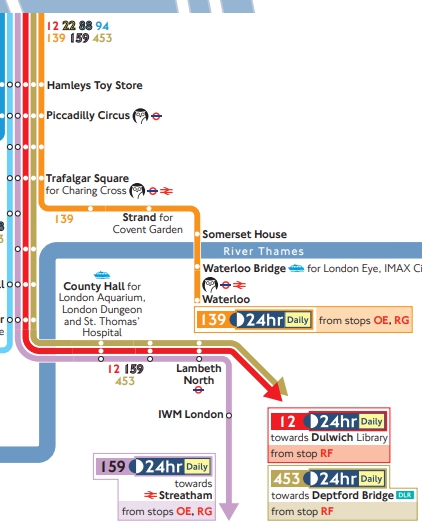
The new Spider maps from Transport for London (TfL) no longer "go all the way" to the end of the route. Once 12, 159 and 453 get to Lambeth North, the only significant information given is the terminus. This need not be. Continuing from fbb's geographical "local" map, it should be possible to show at least some increase on the non information from TfL.

The question is how much - and how?

One option is to show a straight line.
The 94 is, pretty much, a straight line, as are 159 and 88 (running south).
Streatham is much further south than Clapham Common; so should fbb make some attempt at relative scale? 

There again, is it right to show routes that are very much NOT a straight line as just a meaningless stick?

Service 12 would be a challenge as a straight line.
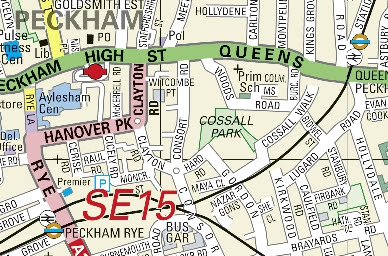
It must be a rarity, in that after saying bye-byes to Elephant and Castle, route 12 does not call at ANY railway station! Surely, we hear you cry, there are stations at Peckham?
Peckham Rye is bottom Left, Queens Road Peckham is top right. But service 12 misses them both - and we all know why, don't we? Historically these stations belonged to Br*t*sh R**lw*ays and not to London Transport, so, historically again, interchange at them was considered of less importance. Peckham Rye now has Overground but this is still a National Rail operation, only managed by TfL.

London really does need one single railway system with one single set of fares. Oyster and contactless help, but only by burying the differences in an electronic obfuscation heap - should be better.

To help folk understand its massive wiggle, fbb has shown its shape, if not its scale.
Scale rears a very ugly head in the North West. On this "proper" map note that Edgware is top left ...
... and Golders Green somewhere in the middle. They are some distance apart, namely 5.3 miles. They were close together on the old Oxford Circus spider and fbb has no choice but to play fast and loose with distances, even on his version.
Here, fbb has experimented with thinner lines outside the box, a device that looks promising. And remember what TfL offers ...
... no attempt at all to provide any geographical context. Edgware is now East of Golders Green, rather than North West! Poor.

Please remember that this is fbb's "work in progress" and more careful cartography, more tormented thought and more attempted adjustments will be necessary. But fbb has come to one massive conclusion. To prove (or disprove) the concept, he must tackle another area.

Euston? Should be fun. Could you merge Euston and Euston Square, separate spiders from TfL, but arguably, one interchange blob?

Don't worry; there wont be yet another burgeoning burst of boring of blogs, but the end results may find their way into a weekend variety posting.

Docklands Developments
Pictures have emerged recently of the new trains being built by Spanish Outfit CAF (Construcciones y Auxiliar de Ferrocarriles) for the Docklands Light Railway. It maybe technically "light" in construction, but it has certainly become heavy in scope. Remember when diddy two car trains trundled between Stratford, The Isle of Dogs and Tower Gateway?
London threw these little beauties away, but some are still running in Essen, Germany.
Currently, Docklands Trains are still two car, but normally run in pairs or triples, four car or six.
We need to realise that the new CAF stock will be formed of FIVE car sets.

Here is what a blogger writes about the new stock.

Although details could change, the current plans for the new trains are:

To replace Stratford International to Woolwich Arsenal 2-car services with new full-length trains and improve peak service from a train every 8 minutes to one every 4 minutes.

Replace the Bank to Woolwich Arsenal and Bank to Lewisham 3-car services with new trains.

Introduce a new peak Stratford International to Beckton service with 3-car trains.

Replace all Stratford to Canary Wharf 2-car services with new full-length trains and extend all these services (i.e. every 4 minutes) to Lewisham.

The result of this on the Lewisham branch there will be a 65% increase in peak capacity compared to today, through a combination of making all trains full length, the higher capacity of the new trains, and the increase in total frequency from today’s 22.5 trains per hour to 30 trains per hour (every 2 minutes). 

TfL will also double the capacity to Beckton, nearly double capacity to Woolwich, and between Stratford and Canary Wharf by 65%.

Wow!

But you will still be able, if you are lucky, to grab a front seat and see where you are going, even drive the train in your imagination.
That front view is really entertaining and informative; even if you have to travel to a terminus in the back, stay put and grab your view for the return journey!

fbb Mansions : Decorations Phase 2
At first, the fbb magnum opus, decorations-wise, could seem to be a bit of a hotch-potch. The frame has been rebuilt (with right angles this rime!) so it looks less wonky, but can we see what's going on? There is an outer border of coloured lights which, as is normal with these LED twinklers, can be set to perform a variety of colour combinations and flash patterns.
In the centre is a Christmas Tree which might be nothing more than a pagan mid-winter festival symbol of new "evergreen" life.
Not only does the Bible begin with The Tree Of Life (Not Adam's Apple, that is tree number 2) but it ends, in the Book of Revelation, with, guess what, The Tree Of Life, its leaves for the healing of the nations, Jesus never said "I am The Tree", but he did say "I am The Vine and you are the branches" so, staying "connected" with Jesus brings life from the Jesus' "grape tree".

In the centre of the tree is The Cross ...
... a reminder that Jesus did not stay a baby! The Bible tells us that he grew up, died and rose again to change lives totally. The true  Christ mas is meaningless without Easter and Easter is meaningless without the empty tomb.
And Jesus did say "I am The Light of the World" - in today's dark days, surely we need God's Light as well as sanitiser, social distancing and gangster gear.

But there again, maybe most people passing the fbb's anterior portal will probably not even begin to join the dots and just see a mush of pretty scintillating colour. That's still good and cheering.

It is infuriating that the light string as manufactured has one blue LED amongst the red and yellow. It always shines out about 100 times more brightly than the rest.

==============================
WARNING
The fbb's modem/router died on Monday
It is being replaced today.
fbb's new laptop also arrives today.
Blogging may be interrupted.

fbb is currently borrowing his neighbours'
internet (with permission) but the
arrangement is not ideal bandwith-wise.
==============================

 Next Photo-Album blog : Thursday 26th November 

Tuesday, 24 November 2020
The Mysterious Madness Of Mapping

To See The Problem ...

... you could download the Oxford Circus "spider" PDF and work it out for yourself. If you are not a well trodden London explorer you might find this a bit of a magical mystery tour. Suffice it to say that Transport for London (TfL), as part of their on-going policy to remove all maps from public gaze, have withdrawn lots of spiders and greatly reduced the scope of others as they are updated. Now, instead of showing the whole route, detailed information ends at an arbitrary boundary - e/g/ for the Central area, not too par outside the Congestion Charge boundary.

Assuming that few passengers have the stamina to make long journeys by bus from Oxford Circus, this may be a good idea. But it might mean that there is now no need to have a spider at all; you could have a real map, an accurate map which shows places in their correct geographical relationship.

Have a look at this extract from TfL's re-jigged spider for Oxford Circus.
In fact, Edgware Road Station is a short walk due West of Marylebone, about as far west as Baker Street is to the East.
Maida Vale is some distance North west of Edgware Road. Then there's the Paddington area.
In fact Lancaster Gate is very close to Paddington ...
... so much so that those "in the know" toddle a few hundred yards to catch a Central Line train rather than taking the Circle/District to Notting Hill Gate and changing.
It really is only a short walk.
Paddington Station is obvious; Lancaster Gate Underground station is, of course, underground; but the entrance is near (very near!) the tower block bottom centre.
Seemples!

A geographical map would show this and make travel decisions much easier. Outside the core area of the former spider, diagrammatic lines will suffice as few will be travelling that far from e.g. the Oxford Circus hub.

So, where to start. 

First, gather your resources, your sources of information. Probably the best start in one of the maps that TfL no longer deigns to produce, in this case the "Central Area" map.
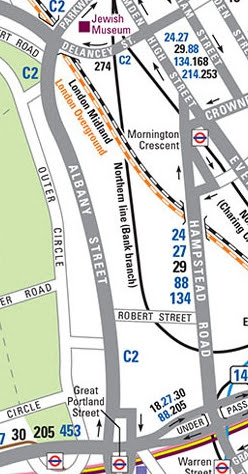
Of course, things have changed since it last appeared, so your noble cartographer needs to keep his aged wits about him. The map shows route C2 as running via Albany Street ...
... and the 88 via Hampstead Road. Now the 88 has replaced the C2 and runs via Albany Street, close to Regents Park.

The route maps for each service on the  TfL site can help a bit ...
... and TfL's list of stops is available, but hard to use.
Google Streetview can help with checking individual stops ...
... provided the noddy car clicks its camera shutter at the right angle!

Finally, you can match it all up with the excellent Collins Street Map book.
fbb found himself referring to all the disparate information sources, and even then found some things difficult to resolve.  But the first results are encouraging.

Here is Marylebone ...
... here is Paddington ...
... and here is the revised 88.
Put all the variegated effort together and this is what you get (click on the map below for an enlargement).
If grappling with enlargements is not your desire, here is a chunk that includes Marylebone and Paddington.
By using the colours and clear route numbers, we can cut out some of the clutter and make the map easier to follow. Anyone who can use a map is not an idiot; they understand that route    7    in purple will be the same as the purple line. Users do not need route numbers scattered in very small print liberally over the map.
Fewer is finer says your noble designer.

There is an important "mantra" for public transport information; "You can either be comprehensive OR comprehensible, not both."

There is a question as to what to include and what to leave out. Here, more debate with potential users is needed BUT most users will find it easier if the graphics are uncluttered and simple. 

Harry Becks original Undergound maps was thus, and look what we have done to it today!
Sorry Mr Beck, honoured and revered Sir, we do seem to have lost the plot by over plotting!

A slightly lesser challenge (surely) is to add the outer bits of the routes which will remain diagrammatic.

More tomorrow.

A Little More On The 484
After crossing on the Wightlink ferry (two crossings, one for each car) the cars were taken to the sidings at Sandown where they were hauled off the low loader ...
... and coupled together on the rails, model railway style! This was in the darkness of the early hours.
The two car train then travelled under its own battery power ...
... to the depot at Ryde St Johns Road, where it settled down for the night after a very exciting day for a two car electric train.
And here it is compared with the existing luxury stock back at Sandown.
Thanks to Senior Island Correspondent, Alan, for sending the picture and even more thanks to chum and former colleague John for getting up in the dead of night to watch the transfer from low loader to depot. 

Nothing much ever happens on the Island, so this must have excited the locals nearly as much as when Queen Victoria bought Osborne House.

 Final Spider Episode plus : Wednesday 25th November