Monday, 27 June 2016

An Academic Problem (1) ...

Dodgy Data Delivered for Diversions
According to one Sheffield correspondent (John), publicity was good.
But fbb did not spot the stuff mentioned above but only started looking on Saturday when he was phoned by lorry driving chum David (a Sheffield resident, but a car driver) asking what was going on.

An innocuous notice has indeed appeared on the Travel South Yorkshire web site, well buried in a section headed "News and Updates", a section which, fbb guesses, will not be read by many passengers, even if they could find it.
Click here and it takes you to a bus/tram/train choice:-
The news was No 3 on the Sheffield list. fbb has added a few notes.

Services 51, 52, 52a, 95 City Centre route changes

There are no changes to the routes in the city centre. And what about 273 and 274?

Western Bank/Brook Hill/Hanover Street/Gell Street pedestrianisation works from Monday 13th June.

None of these roads is being pedestrianised! The notice was published on-line on Saturday 18th June, six days after the routes changed.

Services 51 (Charnock), 52 and 52a (Woodhouse) are normal to Western Bank then will turn right onto Clarkson Street at the Children’s Hospital. They will then turn left onto Durham Road, where there will be a new bus stop, before joining Glossop Road then West Street.

Correct but what about 273 and 274?

Part of Western Bank (near the Octagon Centre), Brook Hill Rounabout and Gell Street will not be served.

It would be better to have simply listed the stops that will no longer be served. Two will cease to exist; the "to city" University stop at the top of Hounsfield Road and the stop on Gell Street.
Western Bank stop


Services 51 (Lodge Moor), 52 (Hillsborough) and 52a (Loxley) to destinations listed are unchanged.

52a does not run to Loxley!
52a runs to Wisewood - NOT Loxley

Service 95 to Sheffield is normal to Bolsover Street then will go straight across at Brook Hill roundabout, before turning right onto Mappin Street and then left onto West Street. There will be a new bus stop at the West Street end of Mappin Street.

Gell Street and the top part of West Street will not be served.

Again, the existing stop on Gell Street (top left of map extract) and the "to city" stop at Regent Terrace (on West Street) will be omitted.
Service 95 to Walkley is unchanged.

It really is beyond belief that the PTE's explanation of all this is so utterly misleading and incompetent. You would have to conclude that nobody at PTE towers knows where the buses go.

Correspondent John seemed to think that the leaflet was "good"; fbb has asked the PTE to send him one. We shall see.

But, fbb asks himself, what is all this about?

We need to back to the days of the trams. Two main services left Sheffield Centre via West Street; they both forked right as they crossed Upper Hanover Street ...
... and they clanked and clanged up Hounsfield Road. At the top, where now are steps)  was a junction. Here trams to Walkley went straight on along Winter Street and those to Crookes turned left and continued to climb up Western Bank past the University.
You can just see a tram on Winter Street in the picture above. Now the "points" (technically known as a "frog") are normally worked electrically. If the tram driver is drawing power from the overhead, this trips a relay and the "frog" clicks over for the deviating line. If the driver switches power off and coasts through the junction he will go straight on.

But because the junction at the top of Hounsfield Road was on a hill, the driver could never coast. So a pointsman stood in a little hut and manually changed the "frog" as the appropriate tram approached.
It was the only such location in Sheffield.

The view now is very different.
Hounsfield Road is a cul-de-sac; Winter Street has been swallowed up by the University but went straight on through the tower block whilst buses to Crookes (as above) and Walkley are diverted. But here is a tram from Crookes ...
... about to turn right to go down Hounsfield Road.

Pre WW2, Sheffield University (located behind the photographer above) was a very modest affair; a three-sided block squeezed in to rows of terraced houses.
But by the time fbb arrived at the cloistered halls of academe in 1963 there had been much expansion. Here a No 52 bus prepared to turn right down Hounsfield Road as did the tram above, but the Uni has grown.
In this pictures you can see the Chemistry Department (left) and part of the Maths block (right). A new Students Union and catering block replaced housing on the south side of Western Bank and the huge Arts Tower arrived while fbb was at his studies.

The Google Earth view shows how much more there is today.
The "post WW2" building is the three sided block with the green courtyard at the top of the picture above. The closed Hounsfield road angles up lower left and the former Winter Street is a car park with the Arts Tower centre right.

Down the road and much nearer the city centre were the Engineering Departments.
Back in the early sixties these were regarded as "slightly inferior" to the main and "proper" University on Western Bank. Academic snobbery was not unknown, even in the "red brick" community. But even as fbb departed from full time education to start earning a crust as a teacher, there were plans to expand by linking to two sites into one mega campus.

It is the consequences of this subsequent expansion which has caused the changes to bus services so inadequately explained by the PTE.

As we shall see tomorrow.

STOP PRESS
fbb has just found the leaflet referred to by correspondent John at the top of this blog. It is on the First South Yorkshire site.
Again, no mention of the 273 and 274, but it does explain the changes without some of the confusion.
There is also a very clear map.

Such a pity the leaflet was removed from the PTE site.

Stagecoach keeps it very simple with no unnecessary clutter.

From 13th June there is a change to service 52 bus route

Bus service 52 will now turn right onto Clarkson Street at the Childrens Hospital. They will then turn left onto Durham Road, where there will be a new bus stop, before joining Glossop Road then west Street.

The outbound service is unchanged

Maybe the PTE should ask the man from Stagecoach to compose its notices.

 Next Sheffield bus blog : Tuesday 28th June 

Sunday, 26 June 2016

One (Two) Three and Brake

But First, a P.S.
Correspondent Peter reminds fbb that the roots of Southern's problems (see yesterday's blog) were sealed into the terms and conditions of the mega franchise that was awarded to GoAhead (strictly GoVia). Driver Only Operation, ticket office closures etc. etc. were built in to the terms of the deal. So, financially, the company has no choice - it has to be delivered.

So from day one the Unions we ready for a long fight.

The RTMnews web site ...
... thus reported, back in 2014.

Back to Our Enigmatic Headline
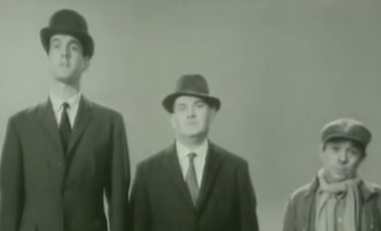
John Cleese, tall and patrician in appearance and demeanour, represents the upper class; Ronnie Barker, of average height, the middle class, and Ronnie Corbett, short in stature, the working class.  Each in turn describes their social advantages and disadvantages, and contrasts them with their neighbours, an effect emphasised by the actors' relative heights as they look downwards or upwards to each other:

Barker: "I look up to him [Cleese] because he is upper class, but I look down on him [Corbett] because he is lower class."

Corbett: "I know my place."

So, historically (in the 19th century), the railways of Britain had three classes bnoradly designed to cater for the three "social" strata of society.
2nd class largely disappeared as 19th became 20th century - leaving a typical UK anomaly of trains offering First and Third class but not Second. There was a "good" reason for this silliness; the Law required all train companies to offer First and Third class on ALL trains with no obligation to provide Second.

Third was renamed Second in 1956 and renamed again as Standard in the early 80s.

But to cope with the legal requirements and to ensure that the superior class was always available to bring in loadsamoney, the railways needed to be very clever with their coach design. For lightly used services they cam up with the composite coach.
This vehicle (at the Keighley and Worth Valley Railway) shows one solution. The first class compartments (labelled "1") had their own corridor leasding to their exclusive toilet in the centre of the carriage. The snivelling third class "lower orders" had a corridor on the other side leading to their toilet 0 and ne'er the twain would meet! Note that there was no connection between coaches; this version was NON-gangwayed.

Carriages with both classes were called "composite". Later versions were even more multi-purpose. They included a guards compartment complete with emergency brake controls.

Guess what? These were called "brake composite".

And fbb bought one.
This preserved version does not have a "1" added for the first class bit, but careful observation reveals that the two windows nearest the guards van (brake) are spaced further apart; a few extra inches of leg room for hose wealthy enough to pay the premium.

But fbb has not bought a real full-sized carriage, merely an 00 gauge model. It looked like this:-
It was, as you would expect with fbb, pre-owned and cheap (£10). It was green with a white roof and was, indeed, a brake composite vehicle. The three compartments (left-ish) next to the guard's van have slightly wider pillars between the sets of windows and door. If your eyesight is good, you might be able to read the word "first" on those three doors.
But what was it? Who made it and when?

The inside of the coach walls carried the number R428 and the chassis had a small "Triang" imprint. And here, ta da!, is R428.
Not all fbb's readers are interested in the model scene, but even the most bored will spot that the carriage is not green. The shape looks similar but green it definitely isn't. In 1963 Triang introduced a very fine model (for its day) of the celebrate "Caley Single"; i.e. a loco with a single driviing wheel (well, one each side!) built for and operated by The Caledonian Railway.

Here is the real thing.
Caledonian Railway Single No. 123 is a preserved Scottish steam locomotive. The unique 4-2-2 was built by Neilson and Company in 1886, works No. 3553, as an exhibition locomotive. In 1914 it was placed on the Caledonian Railway duplicate list, and renumbered 1123. It entered London, Midland and Scottish Railway service in 1923 and the LMS renumbered her 14010 and gave her the power classification 1P. During the 1920s it was allocated to working the directors' saloon, but it was returned to ordinary service in 1930. The locomotive was withdrawn in 1935, by which time it was the last single-wheeled express engine running in Britain, and set aside for preservation.

And here is the model as sold in a set with R427 and R428 coaches.
But the R428 coach still isn't green!

Thanks to the wonders of the interwebnet and some diligent keyboard prodding, fbb was able to resolve the problem. Those cunning people at Margate (former HQ of Triang) had used the moulds of an R428 and filled them with green plastic goo to produced a "Southern Suburban 1938 coach" ...
... and they renumbered as R479 in the catalogue. Here it is:-
It was only produced from 1971 to 1973, so fbb's model is at least 46 years old. Seen here peeking out from Peterville tunnel with its companion "Terrier" named and numbered as an Isle of Wight engine ...
... it is obvious that the quoted colour of the carriage, viz "olive green", is not right. Southern's "olive" was quite a dark and rich colour seen here on a preserved coach at the Bluebell Railway.
The "cheap and cheerful" coach that fbb has bought is probably not an accurate model of anything that the Southern Railway ever ran. The green plastic looks wrong, the white roof looks wrong and the model is empty, devoid of compartments and seats. Modern models are much more fully detailed, almost always models of a specific vehicle and ...

... frighteningly expensive.
Hornby Maunsell brake composite, £38. OUCH.

So perhaps fbb could "fettle up" his 43 year old model to make it look a bit better. Maybe - but that is another story and another blog.

 Next Sheffield bus blog : Monday 27th June 

Saturday, 25 June 2016

They Tried to Run a Railway ...

... and Failed?
One of the best books, and surely essential reading for ALL current railway managers, is "I Tried to Run a Railway" by the late great Gerry Fiennes. (Fie as in "fie to you, good sir" with "nnes").
fbb lent his copy to a chum and has never got it back! Fiennes lost his job with British Railways as a reward for his honesty. It would be fair to say that, although he had union trouble at times, his big bugbear was with the British Railways Board [BRB] and its repeated changes of policy.

Replace the BRB with Department for Transport [DaFT] and Gerry Fiennes with Charles Horton, ...
... GoAhead's rail boss, and you have a similar challenge.

How did we get to this position? Four chunks of the privatised railway have been glued together by DaFT to form the huge GTR franchise. 

"Southern" is successor to the London Brighton and South Coast Railway, later the "Central" division of the Southern Railway operating services out of London Victoria.

"Great Northern" (formerly West Anglia and Great Northern) covers the suburban services operated out of Kings Cross.

"Thameslink" created the beginnings of the oddities by taking suburban services into St Pancras though the reopened Snow Hill tunnels and south to Brighton.

Add to the mix "Gatwick Express" which, under British Railways, was hijacked by the InterCity "Sector" and the grounds are prepared for the present "troubles". Under privatisation this created three separate railway companies vying from business south of the Thames. Commercial freedom for the benefit of passengers or recipe for utter chaos?

To finally stir the pot, the "Thameslink 2000" project staggered into life after years of alternating proposal and postponement making it necessary to rewrite the business structure. This massive engineering project, including the rebuilding of |London Bridge Station is due to take even more trains through the tunnels.

Exciting times but challenging times for management.

Which leads us to Southern's guards.
Historically UK (and US) stagecoaches needed to carry an armed guard to protect passengers and their belongings from attack. In modern railway terms the guard was/is still charged with passenger care and protection leaving the driver to concentrate on driving.

Guards, you may remember, would sprint along a train slamming the doors, blowing whistles and waving a green flag for the "off". Now, doors are controlled centrally, the starting signal is an electronic ping ping. On the London Underground and some suburban "big railway" lines, guards have gone, leaving the driver in sole charge of train and passengers.

So what's up with Southern? fbb's recent journey to spend a few days with No 3 son experienced train cancellations caused, we are told, by "staff sickness". (read again). And then there were strikes.

The beleaguered Mr Horton shot off an email to his customers.
The text went on to stress that no guards would lose their jobs; no guards would get a pay cut; all that would happen would be that the drivers would operate the train doors thus release the guards to spend more time with the passengers.
But the Union doesn't see it that way.
Of course,playing the "safety" card is nonsense. Passengers are no more or less safe whoever operates the doors. On the other hand, if Mr Horton really has no plans to remove guards from trains why provoke a hoo-hah?

Now comes the "thin end of the wedge!" argument. IF the guard doesn't have to operate the doors, then a train can "safely" run without one. So the next stage IS Driver Only Operation.

Maybe the Union is right. Maybe the paymasters and policy pushers are, indeed, the DaFT. Southern is run on a "management contract" whereby they run the trains for a fixed fee and the Treasury keeps the fares revenue. So the Company might not lose a penny if there is a strike; in which case why not force the issue.

Only the passengers suffer a bit. Ha Ha!

But it never rains but it pours (literally). The Company struggled through the strike on 21st with major service changes, (click on the map extracts to enlarge then)

Inner suburban routes ran normally (GREEN lines) ...
... because they don't have guards anyway! The main lines (ORANGE) ...
... had a reduces service. On the RED lines, no Southern trains ran.
As well as the missing links above, there was no Southern service between Dorking and Horsham ...
... and west of Chichester.
So for longer distance travellers, a day of crushed misery at best. No further strikes have been announced, but "staff absence" will continue to be a problem.

But last week, after struggling through Tuesday 21st, poor Mt Horton and his chums were dealt another blow on Wednesday and Thursday.
Oh dear. Third rail electrification and signal cables are not the best friends with flood water ...
... as you can see.
"He tried to run a railway", how he tried!

 Tomorrow a one, three and brake blog : Sunday 26th June 

Friday, 24 June 2016

The Greyhound and The Fox Part 6

But First : The Omnibological Referendum
A tea room in Little Braxted adorned by an LT "r3ed bus" bus stop flag.
A bus in Hull ...
... although fbb has not been able to find out which bus it was. If the smooth floor is anything to go by, it was not a bus currently used in service!

Just spotted it. East Yorkshire (EYMS) single deck pictured in ITV news. Too quick to photograph.

And from 1979ish, a bus parked in a field in Bardfield.


CityFox Responds
Tuesday's blog caused a bit of a kerfuffle, although its content was factual, being a list of the companies that form the CityFox Group and their activities according to reliable Bristol bus watchers. Rhys Hand ...
... MD of the group has occasionally responded on-line to others; this from a riposte to comments in a forum for West Midlands bus people. It was a lengthy reply and fbb here quotes from some of the less specific items.

In July 2014, I decided (madly) to start a taxi business. Currently we have 18 Hackney taxis operating in Bristol and most can be found at Temple Meads Station. I am happy with our trading situation in Bristol and feel we have a strong team.

In September 2014, we enquired about the sale of Whittle Bus & Coach, We viewed the business with Barclays and secured finance to purchase. We discovered there were many outstanding debts and the bus business had been allowed to run into the ground to the point it was not viable.

November 2014, we looked at the sale of the Western Greyhound business, and submitted a offer. This was rejected and was subsequently sold to Micheal Bishop for £20k. We knew the state and investment it needed and that reflected in our offer price.

In January 2015, we met with Barclays and finalised a business plan to create KernowFox. We acquired the remaining buses and assets of Cornwall Busways.

In March 2015, we viewed and looked at the remaining assets of Western Greyhound. We have submitted offers and I have been told (Monday this week) that they'll get back to us in the next few weeks. Summercourt still is yet to be disposed of and its still full of equipment.

Of course, things have moved on since this exchange was published. Phys concludes:-

What I will ask is to please stop the negativity, if KernowFox goes '---s' up fine, then go for it. But this industry is tough, and we all, enthusiasts, industry workers and business owners need to stick together. I want this to work, I want to give people of Cornwall a bus service they can rely on.

The response to Tuesday's blog, however came from Phil Stockley, boss of T M Travel and, unknown to fbb, a personal friend of Rhys Hand.
So here are some of the points Phil has clarified.

Does CityFox (Bus) have an "O" (operators') licence?

fbb did ask whether bus enthusiasts could be informed which company will be operating the 15 minute frequency "Pride" shuttle on 9th July ...
... but Bristol bus nuts will have to wait and see as no detailed info has been received.

What is the status of the much photographed blue bus?

How many taxis does the company have; very few are seen?

Are you happy to be quoted?
fbb also asked about Taxi Operations in Plymouth but no reply was received.
Phil Stockley is a respected bus manager and regular writer in Buses Magazine, and fbb is sure that readers of this blog will appreciate the value of his support for the CityFox group.

If there is a lesson to be learned from this catalogue of misunderstandings, it is surely that multiple twitter accounts and multiple facebook pages are easily misunderstood.
Aspirations and ideas can come over as fact and reasoned criticism, because of the brevity inherent in "social media" can appear blunt and uncaring. 

fbb will be following the group's development with interest and wishes the enterprise all the success that it deserves.

And from RouteOne on-line magazine back in April:-

Phil Stockley is to be Transdev Blazefield’s new Marketing and Commercial Director, starting in August.

He joins from Wellglade and brings 25 years’ experience in senior roles within the bus industry at FirstGroup, Stagecoach, Go-Ahead, as well a period of owning his own bus company, Black Velvet, on the South Coast.
Transdev's boss Alex Hornby ...
... says, “This latest appointment will help ensure we won’t miss a beat and carry on, full force, with our business improvement plans to build an even better Transdev Blazefield. Phil’s skills in the marketing and commercial disciplines will really help us drive the business forward and allow us to seek further opportunities for growth across the north.”

But this is not now happening according to Phil on this blog. The change is no secret, just a reevaluation all round.

But best wishes to Phil whatever!


 Next mixed bag blog : Saturday 25th June